
FOR LABORATORY RESEARCH USE ONLY
What each test measures, why it matters, and how to read a PureX Bio Certificate of Analysis.
LAST UPDATED · 29 JULY 2026
Every vial ships against a published, lot-specific Certificate of Analysis.
ON THIS PAGE
RELEASE SPECIFICATIONS
The release panel
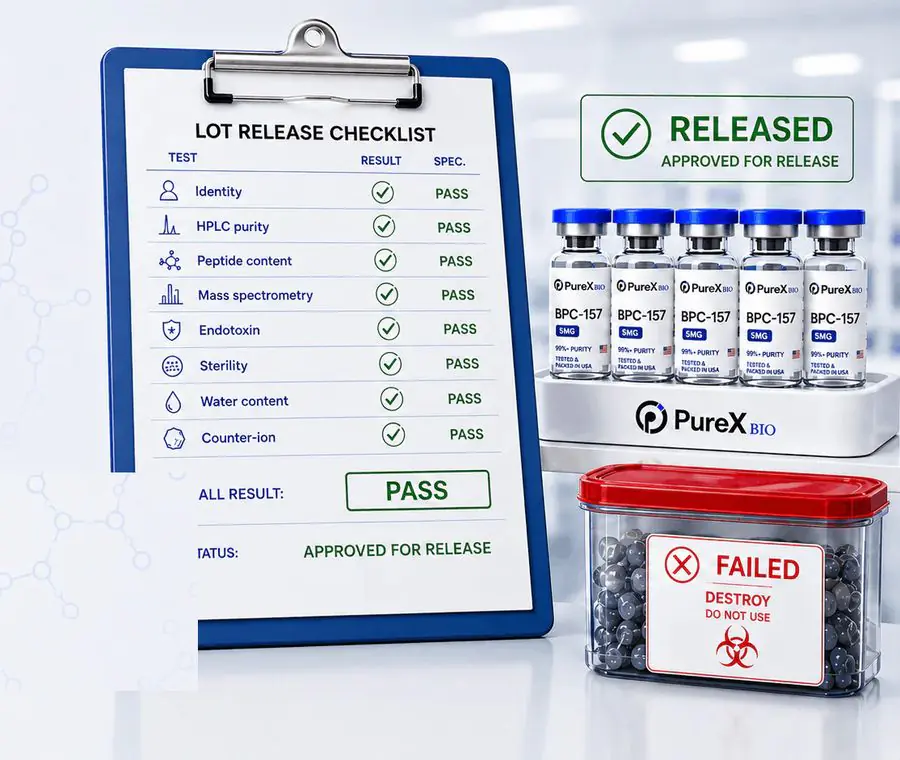
The full panel at a glance. Each test is explained below. Testing varies by lot — review the lot-specific Certificate of Analysis for the exact tests and results that apply to the material you receive.
HPLC Purity
How pure is the sample?
RP-HPLC · area %
≥ 98.0% (spec)
Potency (Assay)
How much peptide is in the vial?
HPLC assay
mg/vial per lot
Identity Verification
Is it the compound on the label?
LC-MS
Compound confirmed
Endotoxin
Is LPS contamination controlled?
LAL assay
≤ 0.05 EU/mg
Sterility
Any viable microorganisms?
USP <71> methodology
No growth
Total Yeast & Mold
Is fungal bioburden controlled?
USP <61>/<62>
Within limits
Heavy Metals
Any As, Cd, Pb or Hg?
ICP-OES
Within limits
08pH
Is the material in range?
pH measurement
5.0 – 8.0
01 · PURITY
HPLC purity
What the headline percentage actually means
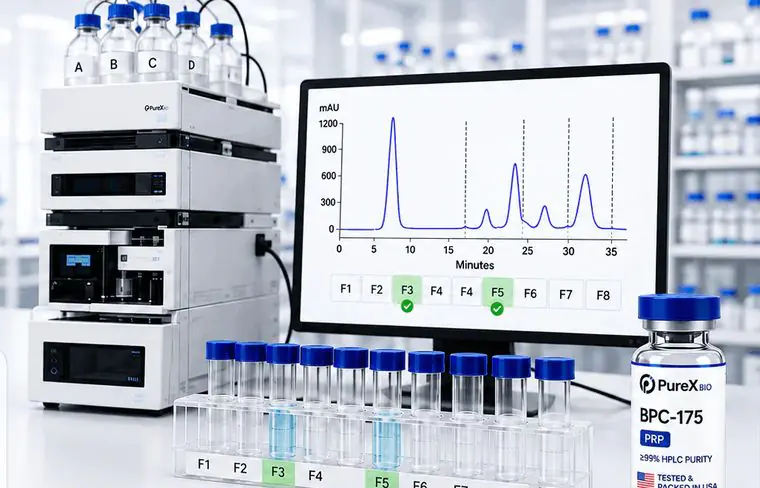
Reverse-phase high-performance liquid chromatography separates the components of a sample by how they interact with a C18 column, measured by a UV detector at 214 nm. The reported result is an area percentage — a result of 99.14% purity means the target compound accounted for 99.14% of the integrated chromatographic peak area.
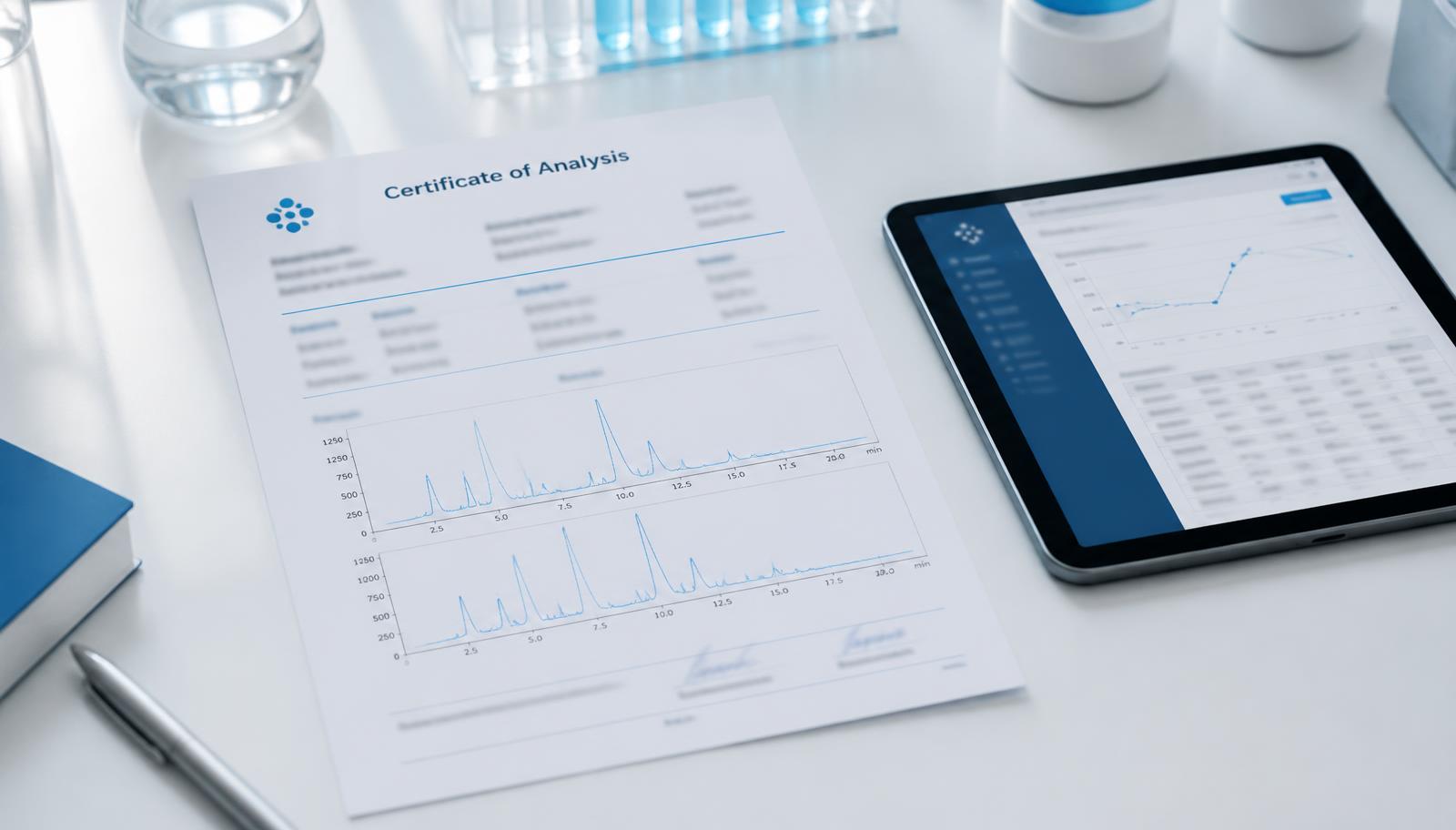
The chromatogram itself is published with every lot. Look for labelled axes, a visible baseline, and clearly integrated, annotated peaks — not just the headline number.
RELEASE SPEC
≥ 98.0% of peak area
RP-HPLC
Area % · chromatogram published
RELEASE SPEC
Reported per lot, by mass
Quantitative analysis
Value printed on each COA
02 · QUANTITY
Potency (assay)
The number purity alone does not tell you
Purity describes the chromatographic profile. Peptide content describes how much of the lyophilised mass is actually peptide — the remainder is counter-ion, residual moisture, and other non-peptide mass associated with the finished material.
A material can test at ≥ 98.0% HPLC purity while having a lower peptide content. These results are not contradictory — they measure different things.
03 · IDENTITY
Identity verification (LC-MS)
Confirming identity
Purity tells you the sample is predominantly one component. It does not prove that component is the compound stated on the label. Mass spectrometry closes that gap by comparing the observed mass against the theoretical mass for the sequence.
An unconfirmed identity result fails release — regardless of its HPLC purity.
RELEASE SPEC
Labelled compound confirmed by LC-MS
Confirmed — releases
Not confirmed — fails, always
Three tests, three different questions
HPLC ASKS
How pure is the sample?
One dominant component in the chromatogram.
POTENCY ASKS
How many mg of peptide are in the vial?
Peptide as a share of total lyophilised mass.
MASS SPEC ASKS
Is it the right compound?
Observed mass matches the labelled sequence.
Only together do they verify a lot — which is why a PureX Bio COA reports all three.
CONTAMINATION & COMPOSITION
The rest of the panel
04 · Endotoxin
≤ 0.05 EU/mg
Endotoxins are lipopolysaccharides from Gram-negative bacteria. They persist after sterilisation and add variability to sensitive systems — so every applicable lot is screened with a kinetic LAL assay, and the measured result is published on its COA.
05 · Sterility
USP <71>
Applicable lots are assessed for viable microorganisms using USP <71> methodology. Sterile filtration reduces bioburden, but process controls are not finished-product testing — where performed, the result appears directly on the COA.
06 · Total yeast & mold
USP <61>/<62>
Microbial enumeration measures fungal bioburden in the finished lot rather than assuming it away. The result is reported on every certificate.
07 · Heavy metals
ICP-OES
Arsenic, cadmium, lead and mercury are measured individually against action limits by ICP-OES, with each analyte and its result printed on the certificate.
08pH
5.0 – 8.0
pH is measured and reported per lot. Many lots also carry water activity and residual solvent (GC-MS) results on the same certificate.
CERTIFICATE OF ANALYSIS
SPECIMEN
Lot number
PX-[LOT]
Release date
[DD MMM YYYY]
Purity / potency
99.14% · [mg/vial]
Identity verification
confirmed by LC-MS
Endotoxin
≤ 0.05 EU/mg
Chromatogram — labelled axes, visible baseline, annotated peaks
SIX CHECKS, THIRTY SECONDS
Reading a Certificate of Analysis
1 · Match the lot number to the vial in hand. If they differ, stop and verify.
2 · Check the release date — specific to the lot, not reused across products.
3 · Look for both purity and potency — two numbers, two different questions.
4 · Confirm identity was tested — the labelled compound confirmed by LC-MS.
5 · Check endotoxin — a measured result, not just a pass mark.
6 · Review the chromatogram — labelled axes, visible baseline, annotated peaks.
Every released lot, searchable by lot number.
Testing is one part of the process
Quality Process
How a lot moves from documentation to release — and what fails it.
COA Library
Find your lot’s certificate and verify it before you buy.
Scientific Advisory
Who reviews our methods and specifications.
Every lot ships with its data.
Browse the catalogue, then verify the certificate before you buy.
FOR LABORATORY RESEARCH USE ONLY — NOT FOR HUMAN OR VETERINARY USE
Run your next study on verified material
Browse the catalogue, pull any lot's Certificate of Analysis, and see what documentation changes.